


ORA-10121
Oracle Analytics Server (OAS) is a comprehensive, on-premises analytics platform that offers a wide range of capabilities for data preparation, visualization, reporting, and augmented analysis, all powered by AI. It’s designed for organizations that require on-premises deployments, such as those in highly regulated industries or with multi-cloud architectures. OAS is essentially the on-premises version of Oracle Analytics Cloud, providing a modern, industry-leading analytics experience.
Overivew
In fast evolving pace in the digital world, it has become apparent the need for the organizations to scale and meet the demands effectively and efficiently.
Successful business decisions are based on accurate and precise business insights, which requires a mature business analytic capability within the organization.
This course enables the business analysts with the right tools, and processes based on best practices using Oracle Analytics Server.
Prerequisites
Knowledge
Students to this class are expected to have:
- Good business background
- Basic understanding of computer operations skills :such as managing files
Technology
Depending on the delivery method of this course, the students should have :
- A Workstation with Internet browser capability such as (Chrome, Edge, or Safari)
- Good persistent internet connection without blocking firewalls(ideally non corporate firewall protected workstations)
The Labs
Labs would be available for students throughout the duration of the course,
Each student would have their own Oracle Analytic Cloud instance allows students to practice their exercises freely and independently.
Labs covered in this course:
- Lab 1: Visualizing Data
- Lab 2: Semantic Modeling
- Lab 3: Reporting and Sharing
- Lab 4: OAC Administration
Audience
This course is designed to assist and equip the students with the skills and knowledge that allows them perfect their daily tasks with respect to data analysis and machine learning ML, including and not limited to the following categories
- Data Analysts: Understands business the best and formulate concise answers, responsible for collecting, analyzing, and interpreting large sets of data to identify trends, patterns, and insights that can inform business decisions.
- Data Scientists: Model data frames, developing models, using machine learning, or incorporating advanced programming to find and analyze data.
- Data Engineers: Build systems for collecting, validating, and preparing that high-quality data.
- AI/ML Architects: AI architects perform a vital function that could help hasten the technology’s adoption by making it more accessible, scalable, and successful. Explore details about the position and get information on the typical career path.
- MLOps: Build the infrastructure to sustain the service operation and ensures the reliability, scalability, and availability of the service
Timeline
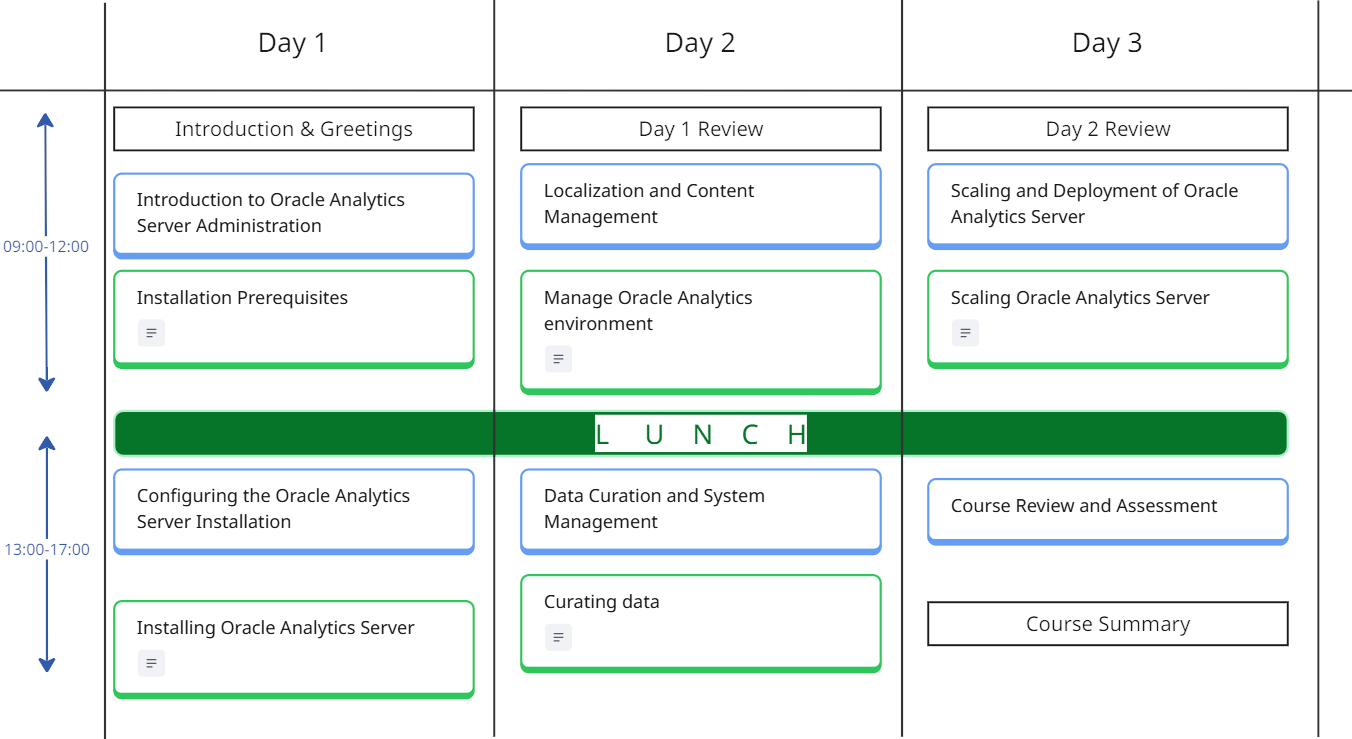
The Oracle Analytics Server Administration Course is a 3 days course, includes lectures, demos, and labs.
The following is guidelines for the instructor to organize the time pace with the students, subject to change based on students preference.
Breaks during the day follows the 106 rule, every 45-60m
*the 106 rule, indicates the human memory capacity to learn the new factual elements which is 106 facts before the memory could be reused.


Course Curriculum
Module 1: Introduction to Oracle Analytics Server Administration
- Understanding the role of system adminisrtation
- Identifying the essential administration tools
- Reviewing and understanding certification information
Module 2:Configuring the Oracle Analytics Server installation
- Establishing connections to external systems
- Adjusting default settings for presentations
- anaging geographic and spatial information
- Setting up time zones for the installation

Module 3: Localization and Content Management
- Implementing localization for your installation
- Setting up currency options as per requirements
- Managing how content is indexed and searched
- Configuring and managing the presentation catalog
- Administering analyses and dashboards
- Configuring and managing agents
Module 4: Data Curation and System Management
- Curating data using scripts for better management
- Operating the system, including start and stop functions
- Taking system snapshots and performing restoration
- Performing common administration tasks
- Applying patches to the system
- Migrating Oracle Analytics Server between environments
Module 5: Scaling and Deployment of Oracle Analytics Server
- Scaling up the Oracle Analytics Server deployment
- Implementing deployment for high availability
- Managing performance tuning and query caching
Module 6: Course Review and Assessment
- Recapping key concepts and practices covered in the course
- Conducting a Q&A session for clearing doubts
- Performing hands-on lab assessment
- Gathering course feedback and providing closing remarks

